
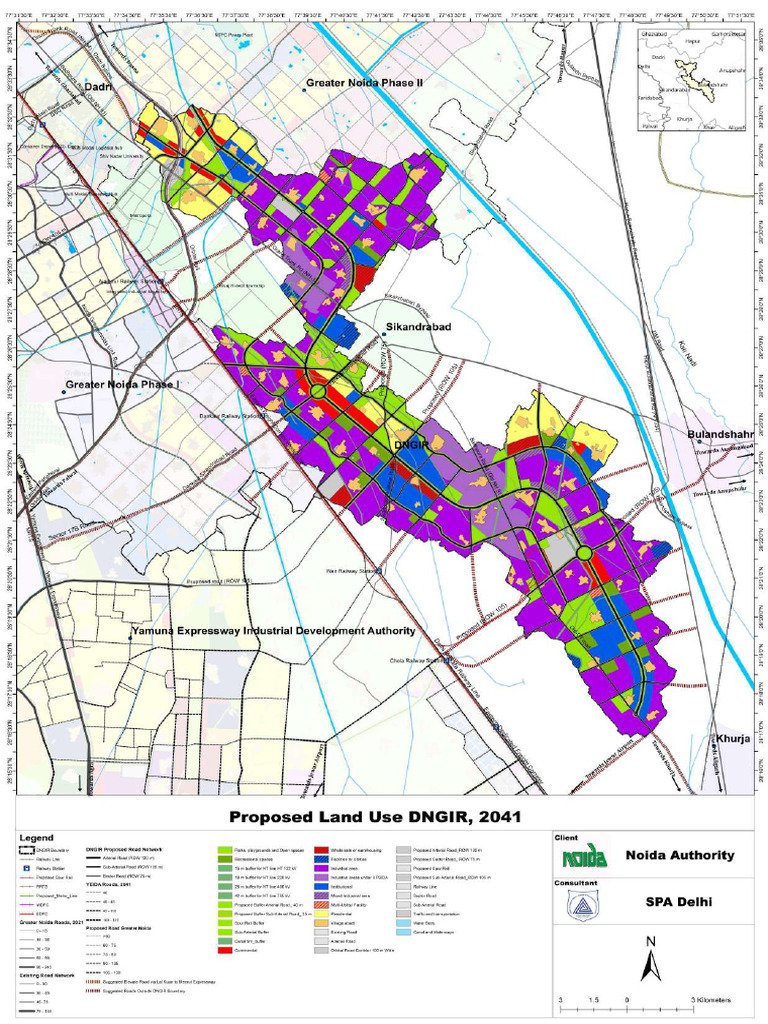
New Noida Master Plan 2041, officially known as the Dadri-Noida-Ghaziabad Investment Region (DNGIR), has moved into a more active implementation phase. The Noida Authority is preparing land acquisition across 37 villages in Phase 1—13 in Gautam Buddh Nagar and 24 in Bulandshahr.
For landowners, buyers and investors, the important point is simple: being inside the wider New Noida planning area is not the same as being part of the current Phase 1 acquisition. That distinction matters when evaluating land, compensation expectations and development timelines.
What Is the New Noida Master Plan 2041?
New Noida, or DNGIR, is a planned industrial and urban expansion zone intended to reduce pressure on existing Noida and Greater Noida while creating a new manufacturing, logistics and employment hub in the NCR.
The notified planning area is about 209.11 sq km. The project is planned in multiple phases through 2041, with around 40% of the land earmarked for industrial use. Residential, institutional, commercial, transport and green areas make up the remaining land-use mix.
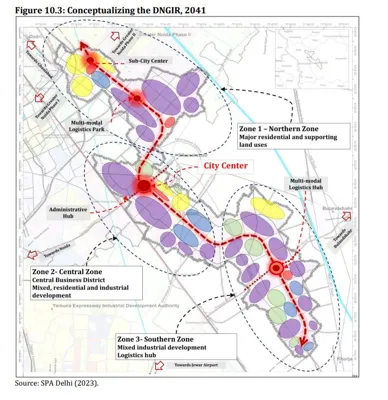
Phase 1 is expected to focus on roughly 3,165 hectares, with land acquisition and revenue verification now receiving the most attention.
New Noida Phase 1: 37 Villages Confirmed
Noida Authority officials have confirmed that Phase 1 will cover 37 villages: 13 in Gautam Buddh Nagar and 24 in Bulandshahr. The acquisition is being planned through a consent-based purchase process.
Public reporting currently names the following villages consistently. Spellings can vary across revenue records and media reports, so landowners should always verify the exact revenue-village name and khasra details with the competent authority.
Gautam Buddh Nagar: 13 Villages
- Anandpur
- Bairangpur urf Nai Basti
- Bil Akbarpur
- Chhayansa
- Daya Nagar
- Girirajpur / Khandera Girajpur
- Kot
- Milak Khandera
- Nagla Chamru
- Nagla Nainsukh
- Nekrampur urf Bishanpur
- Phoolpur
- Sainthali
Bulandshahr: Villages Publicly Named in Current Reports
- Jokhabad
- Sanwali / Senwali
- Birondi Fauladpur
- Birondi Tajpur
- Chola
- Dhimri Aidalpur
- Gopalpur
- Hridaypur
- Kaithara
- Kanwara
- Kadu
- Kishanpur
- Luhakar
- Muradabad
- Nagla Barodha
- Nawada
- Rajarampur
- Rajpur Khurd
- Sabdalpur
- Salempur Kayasth
- Shahpur Kalan
- Sherpur
- Sikra
Important: the Authority-level count is 24 Bulandshahr villages, but the public reports reviewed do not consistently identify all 24 names in the same way. Rather than invent the missing name, this article lists the villages that are repeatedly named in current reporting. Anyone making a land decision should verify the latest official acquisition schedule and revenue records.
Land Acquisition Rate: ₹4,300 per sq m
The Noida Authority has fixed a reported consent-based acquisition rate of ₹4,300 per square metre for the current New Noida land acquisition process. This has been aligned with the revised compensation benchmark used around the Noida International Airport area.
The headline rate should not be treated as a final payout calculator for every parcel. Ownership, land category, title, co-ownership, inheritance records and the applicable acquisition terms can affect the actual transaction.
What Is Happening on the Ground?
The first stage is not simply about buying land. Revenue officials and lekhpals are verifying khasra-khatauni records, ownership, inheritance claims and physical boundaries. Ground surveys are also being used to record existing structures, roads, crops and current land use.
Once acquisition progresses, the Authority is expected to move toward trunk infrastructure such as roads, drainage, sewage, electricity and water networks before industrial and other plots are developed.
Why the 37-Village Phase Matters
The Phase 1 villages are important because they represent the first operational geography where the Master Plan begins turning into land control and infrastructure execution. For the wider market, that creates a much clearer difference between:
- land that is simply inside the larger DNGIR planning boundary,
- land that falls inside the current acquisition phase, and
- land that may benefit from future roads, industrial sectors or logistics connectivity without being acquired immediately.
We have previously covered the New Noida land acquisition process across 37 villages. The latest Phase 1 focus makes it even more important to check the exact village and land record rather than relying only on marketing maps.
How Connectivity Strengthens the New Noida Story
New Noida is positioned close to major regional transport corridors. The Eastern Peripheral Expressway, the wider Ganga Expressway network and access toward Noida International Airport can make the area strategically relevant for industry and logistics.
Our earlier analysis of New Noida connectivity with the airport and Ganga Expressway explains why transport infrastructure is a major part of the DNGIR investment story.
What Buyers and Landowners Should Check
Before making any property decision around New Noida, verify:
- the exact revenue village name and district,
- whether the land falls inside the notified DNGIR boundary,
- whether the village is part of the current Phase 1 acquisition,
- khasra and khatauni ownership details,
- land-use classification under the Master Plan,
- access to existing and proposed roads,
- any acquisition notice, restriction or authority communication, and
- whether a quoted development claim is official or only a private marketing statement.
How The Kapish Group Helps
New Noida is attracting attention because the planning story is now moving closer to execution. That also means buyers need more than a map and a broker’s claim.
The Kapish Group helps clients evaluate land and property opportunities through location analysis, master-plan review, document checks and authority-level due diligence. For New Noida, that means checking whether a parcel actually sits in the relevant planning or acquisition area and understanding what the surrounding infrastructure can realistically mean for it.
Final Takeaway
The New Noida Master Plan 2041 is no longer only a long-term planning document. Phase 1 land acquisition activity across 37 villages shows that the project is moving into a more practical stage.
For investors and landowners, the strongest approach is to separate confirmed planning facts from speculation. Village inclusion, land-use status, acquisition stage and revenue records should all be checked before taking a decision.