

The development of New Noida, officially known as the Dadri-Noida-Ghaziabad Investment Region (DNGIR), is moving toward a new phase, with land acquisition preparations, revised compensation arrangements and plans for a large industrial and urban development hub.
Spread across approximately 20,911 hectares (209.11 sq km), New Noida is planned as more than a residential extension of the existing city. Its master plan allocates substantial land for industrial activity, alongside residential areas, commercial zones, public institutions, green spaces and supporting infrastructure.
The first phase covers 37 villages across Gautam Buddh Nagar and Bulandshahr, with land acquisition planned through mutual consent. At the same time, reported changes to compensation rates and developed residential plot benefits have made the acquisition framework an important consideration for farmers, landowners and real-estate stakeholders.
For businesses and investors, the larger question is how the New Noida Master Plan 2041 could influence industrial investment, logistics, employment, connectivity and long-term real-estate development.
New Noida Project: Key Facts at a Glance
- Official name: Dadri-Noida-Ghaziabad Investment Region (DNGIR)
- Total planned area: Approximately 20,911 hectares
- Planning area: Approxim0ately 209.11 sq km
- Total villages in the notified region: 84
- First-phase villages: 37
- Districts covered: Gautam Buddh Nagar and Bulandshahr
- Development period: Four phases, extending to 2041
- Primary development focus: Industrial, commercial, residential and supporting urban infrastructure
The project forms part of the wider industrial-development strategy associated with the Delhi-Mumbai Industrial Corridor (DMIC). Its location between established urban centres and major freight infrastructure is intended to support industrial growth and employment generation
New Noida Land Acquisition: 37 Villages in Phase 1
The first phase of New Noida’s land acquisition programme covers 37 villages: 24 in Bulandshahr district and 13 in Gautam Buddh Nagar district.
The authority has been preparing to acquire land through mutual consent, with teams expected to engage directly with farmers and verify ownership documents, revenue records and the status of individual parcels.
The 13 villages in Gautam Buddh Nagar identified for the first phase are:
Anandpur, Bairangpur alias Nai Basti, Bil Akbarpur, Chhayasa, Daya Nagar, Girirajpur, Kot, Milak Khandera, Nagla Kamru, Nagla Nayasukh, Nekrampur alias Vishnupur and Phoolpur.
The Bulandshahr group includes villages such as Birondi Fauladpur, Birondi Tejpur, Chola, Dimri Adilpur, Gopalpur, Hridaypur, Jokhabad, Kaithara, Kanwara, Kadu, Kishanpur, Luhakar, Muradabad, Nagla Barodha, Nawada, Rajarampur, Rajpur Khurd, Sabdalpur, Salempur Kayasth, Sanwali, Shahpur Kalan, Serpur and Sikara.
Village names and spellings can differ between reports and revenue records. Landowners should confirm the exact village and khasra details against the relevant official documents before making a transaction.
The first phase is not the same as the entire DNGIR planning region. A property located somewhere within the broader notified boundary is not automatically part of the current acquisition phase.
New Noida Land Compensation: ₹4,300 and the Reported ₹6,459 Rate
Land compensation is one of the most commercially significant aspects of the New Noida development.
In April 2026, reports stated that the Noida Authority had fixed a land acquisition rate of ₹4,300 per square metre for New Noida, matching the then-revised rate offered by YEIDA for the airport-related land acquisition framework.
Subsequently, reports following the Noida Authority’s September 2026 board meeting described a revised rate of ₹6,459 per square metre under a particular compensation category. The reported decision also addressed developed residential plot benefits.
However, these figures should not be interpreted as a single, universally applicable rate for every New Noida land parcel.
The compensation framework varies according to the relevant phase and the applicable benefit structure. Reports indicate that:
- Phases 1 and 2: The compensation and developed-plot framework is aligned with the Greater Noida Authority model, including a reported 6% developed residential plot benefit.
- Phases 3 and 4: The framework is aligned with the YEIDA model, including a reported 7% developed residential plot benefit.
The applicable cash compensation, plot benefit, eligibility requirements and other conditions must be checked against the latest official decision and the specific acquisition arrangement.
What Could These Rates Mean for Landowners?
For illustration, one acre is approximately 4,046.86 square metres.
At a rate of ₹6,459 per square metre, the arithmetic equivalent is approximately ₹2.61 crore per acre before considering the actual terms, eligibility, deductions or other conditions applicable to an individual case.
This is a mathematical illustration, not a guarantee that every acre in New Noida will qualify for that compensation rate.
Landowners should also understand the difference between the cash-compensation option and any developed residential plot benefit. These arrangements have separate conditions and should not be treated as interchangeable without reviewing the applicable policy.
For buyers, the compensation rate is relevant context, but it is not a direct measure of the open-market value of nearby land.
New Noida Master Plan 2041: Land Use and Development Allocation
The New Noida Master Plan 2041 envisages a mixed industrial and urban development model. Reported land-use allocations include:
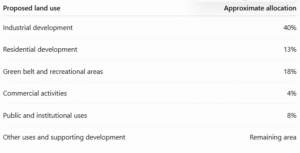
Table showing proposed land use allocations, led by industrial development at 40%.
These allocations illustrate why New Noida should not be viewed only as a future residential township.
The proposed industrial share is particularly important. Industrial activity can create demand for manufacturing facilities, warehouses, transport services, employee housing, commercial services and supporting urban infrastructure.
At the same time, the final permitted use of any specific parcel must be determined from the applicable master plan and official land-use records. The overall allocation does not mean that every property in the region can be used for industrial or commercial development.
Which Industries Could Drive New Noida’s Commercial Development?
The DNGIR concept is intended to support industrial investment and employment generation. The industries discussed in planning-related reports include:
1. Electronics and Semiconductor Manufacturing
Electronics and semiconductor-related manufacturing could form part of the region’s industrial ecosystem, subject to investment decisions, infrastructure availability and project approvals.
These industries generally require reliable power, specialised facilities, skilled workers and efficient supply-chain connections.
2. Automobile and Component Manufacturing
Automobile manufacturing and component suppliers could benefit from access to regional markets, suppliers and freight networks if suitable industrial infrastructure is developed.
The commercial impact would depend on actual company investments and the availability of appropriately designated industrial plots.
3. IT and IT-Enabled Services
IT and ITeS activities could support demand for offices, commercial services and skilled employment, depending on the final industrial and commercial development pattern.
4. Solar Panel Manufacturing and Renewable-Energy Supply Chains
Solar panel manufacturing and related industrial activities have also been identified among potential sectors discussed for the wider development framework.
The eventual scale of this activity will depend on business investment, policy support, infrastructure and market demand.
5. Food Processing, Textiles and Building Materials
Food processing, textiles, garments, cement and tiles are other sectors mentioned in reports on the proposed industrial ecosystem.
These industries may create requirements for production facilities, storage, distribution, transport and worker-support services.
Commercial implication: The real-estate effect of New Noida will depend not only on how much land is acquired, but also on which industries establish operations, how many jobs they generate and what supporting infrastructure is delivered.
New Noida Connectivity: Jewar Airport, Noida and Ghaziabad
Connectivity is an important factor in the DNGIR development strategy.
The region is positioned in relation to Noida, Ghaziabad, Jewar and the wider freight network. Published reports have cited approximate distances of around 33 km from Noida, 24 km from Ghaziabad and 32 km from Jewar Airport, although the actual distance depends on the precise location and route.
The region’s strategic context also includes the Eastern and Western Dedicated Freight Corridors and the proposed multimodal logistics and transit infrastructure associated with Dadri and Boraki.
These links are relevant to businesses that depend on freight movement, industrial supply chains and access to major markets.
However, geographic proximity does not automatically mean direct connectivity. The value of a particular site will depend on its road access, approved transport links, distance to usable freight facilities and the infrastructure actually delivered.
New Noida Development Timeline: Four Phases Through 2041
The project is planned to progress in four phases, with the following reported land-development targets:
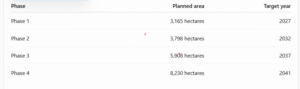
Table showing planned development areas and target years for four phases.
The four phase figures together account for approximately 21,101 hectares, which differs slightly from the headline notified area of 20,911 hectares reported for DNGIR. These figures should therefore be treated as reported phase targets, with the final area and phase boundaries verified against current authority documents.
The phased approach matters commercially because the timing of land acquisition, infrastructure development and industrial plot availability will not necessarily be the same across the region.
A location close to an early development area may have a different implementation timeline from one associated with a later phase.
What Could New Noida Mean for Industrial and Logistics Real Estate?
The proposed development could create several types of commercial demand, but each depends on the execution of the plan.
Industrial plots: Manufacturing businesses may seek land in designated industrial zones, subject to allotment terms and infrastructure readiness.
Warehousing and logistics: Freight connectivity and industrial activity could support storage, distribution and supply-chain operations where suitable land and transport access are available.
Commercial property: Offices, retail, business services and other commercial uses may develop around employment centres and planned urban nodes.
Residential demand: A growing industrial workforce could support demand for housing, but the scale and timing will depend on actual employment creation and the delivery of urban services.
Supporting infrastructure: Roads, drainage, water supply, power, sewage networks and public facilities will be essential to convert the planning framework into a functional industrial region.
For businesses evaluating New Noida, the important question is whether a specific location can meet its operational requirements—not simply whether it falls within the DNGIR boundary.
What Does New Noida Mean for Land Prices and Investment?
The New Noida project is likely to attract continued attention from landowners, businesses and property-market observers because of its scale, industrial focus and planned infrastructure.
Nevertheless, the notified planning area, acquisition compensation and open-market land prices are three different things.
Compensation is determined by the applicable acquisition policy and the specific terms of a transaction. Open-market prices depend on location, demand, legal status, land use, accessibility and other local factors.
A rise in compensation rates does not automatically establish an equivalent increase in the market value of surrounding properties.
Similarly, being near a proposed industrial zone does not guarantee that a parcel will benefit from the same infrastructure, land-use permissions or development timeline.
Before assessing a potential land investment, buyers should establish:
- Whether the parcel lies within the notified DNGIR boundary.
- Whether it falls within the current acquisition phase.
- Whether acquisition is proposed, underway or completed.
- What land use is permitted under the applicable plan.
- Whether the site has legal road access.
- Whether nearby industrial or transport infrastructure is approved, under construction or operational.
- Whether ownership, title and revenue records are consistent.
- Whether the transaction relies on a confirmed approval or an assumption about future development.
New Noida Land Due Diligence: What Buyers Should Verify
A structured due-diligence process is essential for anyone evaluating land in New Noida, Bulandshahr or Gautam Buddh Nagar.
Verify Khasra and Khatauni Records
Confirm the exact parcel, recorded ownership, land area and relevant revenue entries. Do not rely solely on a broker’s location description or a map pin.
Confirm Acquisition Status
Check whether the land is included in the relevant acquisition phase, whether the authority has issued any applicable notice and whether a transaction is subject to acquisition-related restrictions.
Review the Master Plan and Land Use
Determine whether the parcel is designated for industrial, residential, commercial, institutional, agricultural or another use. A broad DNGIR designation does not itself establish development permission.
Check Compensation and Developed-Plot Eligibility
Landowners should verify the applicable compensation rate and any developed residential plot benefit directly against the latest authority policy. Buyers should not assume that the seller’s quoted compensation or plot entitlement applies to every parcel.
Assess Actual Connectivity
Review road access, transport routes, freight infrastructure and planned interchanges. Distinguish a nearby proposed project from a functioning connection.
Verify Ownership and Transaction Documents
Review the title chain, inheritance records, registered documents, encumbrances and any relevant disputes before committing funds.
The correct sequence is:
Proposed → Approved → Under Construction → Operational
Each stage represents a different level of certainty and should be reflected in the property’s assessment.
How The Kapish Group Approaches New Noida Real Estate
At The Kapish Group, infrastructure-led real-estate opportunities are assessed through location analysis, planning review and property due diligence.
For a large development such as New Noida, the headline project area or compensation rate is only the starting point. A useful assessment needs to connect the specific parcel to the relevant authority records, land-use classification, acquisition status, connectivity and development timeline.
Our approach includes:
- New Noida Master Plan 2041 analysis
- Location and connectivity assessment
- Land-use and planning review
- Khasra, khatauni and document checks
- Acquisition-status verification
- Authority-level due diligence
- Industrial and logistics development analysis
The objective is to help buyers and investors understand the difference between a broad regional development opportunity and the verified characteristics of an individual property.
Conclusion
The development of New Noida under the DNGIR framework represents a major industrial and urban planning initiative for Gautam Buddh Nagar and Bulandshahr. The 20,911-hectare notified region, the first-phase programme covering 37 villages, the proposed industrial land allocation and the compensation framework are all important parts of the development story.
The region could support manufacturing, logistics, commercial services and residential demand as infrastructure and industrial investment progress. But the scale of that impact will depend on the execution of the master plan, land acquisition, transport connections and actual business activity.
For landowners and investors, the most useful approach is to evaluate the exact parcel, the applicable acquisition and compensation terms, its permitted land use and the infrastructure that will genuinely serve it.
In New Noida, understanding the planning framework is just as important as understanding the price.